Archive story: a reconstruction written from logs and testimony. Dialogue is reconstructed where no recording exists.
The scars started on floor eight.
Marek had seen them in survey photographs: long vertical gouges in the alloy, regular as a ruler, each one deep enough to lose a hand in. The survey teams had called them drill marks. On floor eight the C-9’s lights caught them up close, and he saw that they were not drilled. They had been hammered. The alloy at the bottom of each scar was folded like soft metal under a punch.
By floor nine the scars were everywhere, and the machines had changed. The Crawlers still came up the walls in their patient lines, and the Runners still sprinted for the lift. But they moved like workers clearing a site. They were not trying to kill him. They were trying to get him out of the way.
Floor ten was silent.
The route marker lit green above him. The guide channel ran on into the dark. No Crawlers on the walls. No Runners. Marek let the carrier drift down on its guides and listened to the coupler hum, and to his own breathing in the cab.
“Sana,” he said, knowing she would hear it minutes late or not at all. “Floor ten is empty.”
Then the wall moved.
It came out of a recess he had taken for a bulkhead: a machine three times the height of the carrier, built around a pile-driving ram as thick as a tree trunk. Its legs were braced against both walls of the shaft. It did not walk down to him. It spanned the shaft, ram first, and the first blow rang the alloy like a bell and threw the C-9 sideways on its guides.
The shield took it. The shield’s energy readout dropped by a third.
“Okay,” Marek said. “Okay. You’re the scars.”
Crawlers poured from the recess behind it, a dozen of them, and went for the mounts. Deploys lesser units to occupy the weapons, the survey summary had said, in the calm voice of people who had never been here. The turrets swung to the swarm, as they were built to. The Crusher drew back its ram.
Marek put the carrier into manual, took the reticle and pulled every cannon onto the guardian’s chest. Let the basic turret have the Crawlers. Yara had said something on that lift had to never run out.
“Guard,” he said, and hit it as the ram came down.
The field flared white. The cab rang. Somewhere a warning tone began and kept going. The cannons answered: slow, heavy, one shell at a time into the plates over the ram’s piston. Then Overdrive, and the cycling rate climbed until the frame shook.
It took four minutes. It felt like a shift. When the Crusher finally folded, it did not fall. It came apart along seams he had not seen, pieces drawing back into the recess, the ram last of all, as if it were being put away.
In the space where it had braced itself was a small housing, open, holding a dark crystal with a faint inner light and a block of route data the coupler drank in at once. The route key. The marker for sector two lit green below him.
Marek sat in the ringing cab and waited for his hands to stop shaking.
“Sana,” he said. “Floor ten’s clear. Tell Yara the turret never ran out.”
Then, after a while: “Tell her there are nine hundred and ninety more.”
Related articles
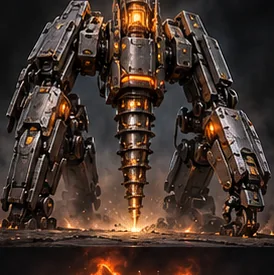 BOSSCrusherBreach-class sector guardian
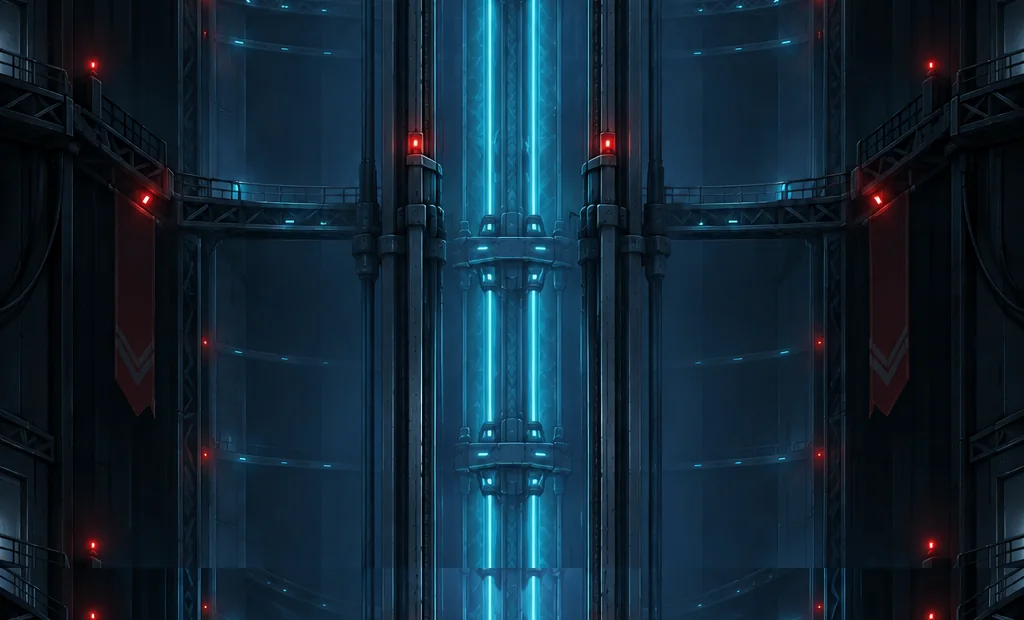 ARCHIVE RECORDIndustrial RiftSector 1. The first mapped galleries: alloy ribs, old rails, a cyan guide channel and the impact scars of the Crusher.
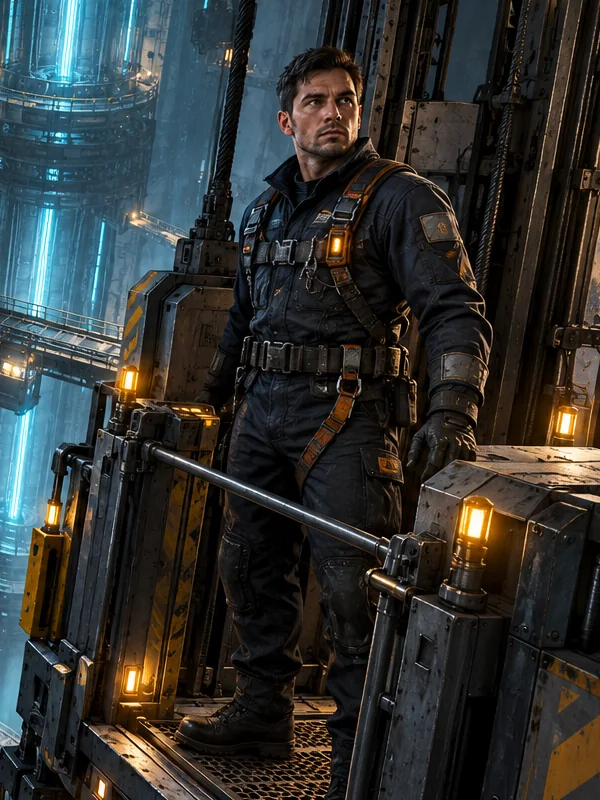 ARCHIVE RECORDMarek VennSalvage pilot, younger brother of Ilyan Venn, and the only person aboard the C-9 when it went down against orders in 2217.
 ARCHIVE RECORDThe descent (2217–)The solo descent of the C-9: what the archive knows of Marek Venn’s route so far, sector by sector.