Archive story: a reconstruction written from logs and testimony. Dialogue is reconstructed where no recording exists.
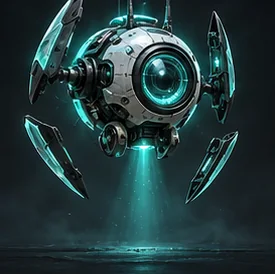
The probe was called K-1 because it was the only one they had. It had been built for mine shafts in the north: a white ball the size of a melon, with a single lens and a cable socket on top. Juno, the youngest of the drill operators, had painted a smile under the lens. Reyes let it stay.
They lowered it at 14:20. He wrote the time in his notebook and underlined it, because by then he had already started to suspect that times would matter.
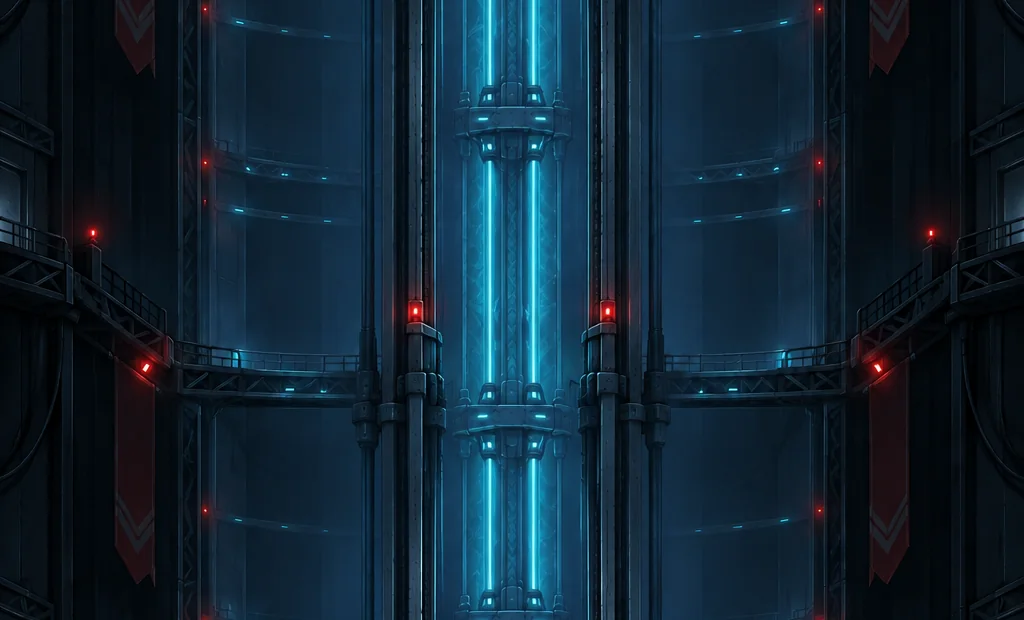
For the first four hundred metres K-1 was unremarkable. The walls were the same ribbed grey alloy as the rim. The cyan channel ran beside it like a lit road. The cable counter and the range-finder agreed to within a metre. Juno read out the numbers in a bored voice, which Reyes found comforting.
At six hundred metres they stopped agreeing.
“Counter says six hundred and twelve,” Juno said. “Range-finder says eight hundred and something. Eight-forty.”
“Recalibrate.”
“I did. It says eight-forty. Now it says eight-ninety.”
The cable had not moved. Reyes looked at the spool and watched it not move.
At 1.4 kilometres by the counter, the cable went slack. The brake held. Nobody spoke. Then the receiver chimed. K-1 was transmitting on its own, through rock that should have blocked it, on a frequency it had never been configured to use.
The packets were clean. Temperature, pressure, a gravity reading two percent too high. A depth that matched neither the cable nor the range-finder. And a timestamp on every packet, from the probe’s internal clock, synchronised that morning to the satellite reference.
The first packet was stamped 14:09.
Juno laughed, a short and unhappy sound. “Clock’s off.”
“Check it.”
She checked the probe’s last confirmed sync. She checked the receiver clock. She checked the satellite. All three agreed: launch at 14:20. The packets agreed only with one another. They ran from 14:09 to 14:28, nineteen minutes in all, and then stopped. The first of them had been sent, by any clock on the surface, eleven minutes before anyone had touched the cable.
Reyes stayed at the rim long after the others had gone to the trucks. The channel glowed below him, steady and unbothered. He opened his notebook to the page where he had written the rift in the basin floor that morning, and crossed out in the basin floor.
Under it he wrote: It isn’t a hole. A hole is where something isn’t.
He thought about the last packet for a long time. It had been the shortest. It contained no telemetry at all, only a timestamp and one image from the lens, overexposed almost to white. In the centre of the white, if you wanted to see it, was a shape like a ball the size of a melon, looking up.
K-1 was never recovered. Its final image is held in the Asterion archive under restricted access. See also Unconfirmed sightings, record U-2.
Related articles
 ARCHIVE RECORDDiscovery of the Rift (2189)A routine geophysical survey of the Khepri Basin finds a shaft where the bedrock should be, and a probe that reports back before it is launched.
 ARCHIVE RECORDDr. Tomás ReyesThe geophysicist who found the Rift in 2189, named it, and spent twenty years insisting that its contradictory measurements were all correct.
 ARCHIVE RECORDRift physicsDepth drift, early signals, warm relays and geometry that folds at sector boundaries: the measured anomalies of the shaft and the rules the crew uses to survive them.
 UNVERIFIED REPORTUnconfirmed sightingsThree machines seen once each, on damaged footage, by single instruments. The archive keeps their records open.