In the spring of 2189 a mineral survey crew working the eastern Khepri Basin lost a core drill. The bit punched through forty metres of sandstone and then kept going, unspooling cable until the brake caught it. When the crew pulled it back, the last two metres of the drill string were polished smooth, as if they had passed through a sleeve.
# The opening
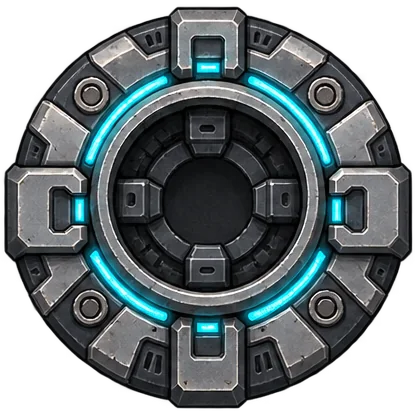
The survey lead, Dr. Tomás Reyes, ordered the site excavated. Three weeks later the crew exposed a circular opening eleven metres across, its rim formed from a ribbed grey alloy that turned every cutting tool on site. The shaft dropped vertically, perfectly straight. Lights lowered into it showed walls of the same alloy, with regular ribs and a channel running down one side that glowed faint cyan when the lights were switched off.
Reyes’s field notebook calls it “the rift in the basin floor” on the first page and simply “the Rift” from the second. The name was meant to be temporary.
# Probe K-1
On the twenty-sixth day the crew lowered K-1, a spherical inspection probe normally used for mine shafts. It descended on a cable for 1.4 kilometres. Then the cable went slack, and the probe began transmitting on its own.
The telemetry was clean. The probe reported temperature, pressure, a gravity reading slightly too high and a range-finder depth that disagreed with the cable counter by four hundred metres. Every packet carried a timestamp. The first packet was stamped eleven minutes before K-1 had been lowered.
The crew checked the probe clock, the receiver clock and the satellite reference. All three agreed with each other. Only the packets disagreed. K-1 transmitted for nineteen minutes and then stopped. It was never recovered. See Eleven minutes early for the crew’s account.
# Aftermath
Reyes reported the find to the regional geological authority, which reported it to three governments within a day. By 2190 the basin was an exclusion zone and the original survey crew had signed non-disclosure agreements in four languages. Reyes was retained as scientific lead. His insistence that the depth readings were correct, just not mutually consistent became the founding assumption of Rift physics.
We did not discover a hole. We discovered that the word ‘depth’ needed qualifying.
— Dr. Tomás Reyes, testimony to the basin commission, 2190
Related articles
 ARCHIVE RECORDDr. Tomás ReyesThe geophysicist who found the Rift in 2189, named it, and spent twenty years insisting that its contradictory measurements were all correct.
 ARCHIVE STORYEleven minutes earlyKhepri Basin, 2189. A survey crew lowers a probe into a hole that should not exist, and it answers before they ask.
 ARCHIVE RECORDKhepri BasinA dry, sealed basin of salt flats and abandoned company towns. The Rift lies beneath it, and nobody without a Directorate pass gets in.
 ARCHIVE RECORDThe survey era (2190–2206)Relays, tether platforms and the first Rift Shard: sixteen years of learning how to go down, and how hard it is to come back.